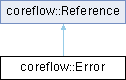
|
| static vx_bool | createConstErrors (vx_context context) |
| | Creates all the status codes as error objects.
|
| |
| static vx_error | allocateError (vx_context context, vx_status status) |
| | Creates an Error Object.
|
| |
| static void | releaseError (vx_error *error) |
| | Releases an error object.
|
| |
| static vx_error | getError (vx_context context, vx_status status) |
| | Matches the status code against all known error objects in the context.
|
| |
| static vx_status | getStatus (vx_reference ref) |
| | Provides a generic API to return status values from Object constructors if they fail.
|
| |
| static vx_reference | createReference (vx_context context, vx_enum type, vx_reftype_e refType, vx_reference scope) |
| | Used to create a reference.
|
| |
| static void | printReference (vx_reference ref) |
| | Prints the values of a reference.
|
| |
| static vx_bool | isValidReference (vx_reference ref) |
| | Used to validate everything but vx_context, vx_image and vx_buffer.
|
| |
| static vx_bool | isValidReference (vx_reference ref, vx_enum type) |
| | Used to validate everything but vx_context, vx_image and vx_buffer.
|
| |
| static vx_size | sizeOfType (vx_enum type) |
| | Returns the number of bytes in the internal structure for a given type.
|
| |
| static vx_status | releaseReference (vx_reference *ref, vx_enum type, vx_reftype_e reftype, vx_destructor_f special_destructor) |
| | Used to destroy a reference.
|
| |
|
| vx_status | status |
| | The specific error code contained in this object.
|
| |
| struct _vx_platform * | platform |
| | Platform for ICD compatibility.
|
| |
| vx_uint32 | magic |
| | Used to validate references, must be set to VX_MAGIC.
|
| |
| vx_enum | type |
| | Set to an enum value in vx_type_e.
|
| |
| vx_context | context |
| | Pointer to the top level context. If this reference is the context, this will be NULL.
|
| |
| vx_reference | scope |
| | The pointer to the object's scope parent. When virtual objects are scoped within a graph, this will point to that parent graph. This is left generic to allow future scoping variations. By default scope should be the same as context.
|
| |
| vx_uint32 | external_count |
| | The count of the number of users with this reference. When greater than 0, this can not be freed. When zero, the value can be considered inaccessible.
|
| |
| vx_uint32 | internal_count |
| | The count of the number of framework references. When greater than 0, this can not be freed.
|
| |
| vx_uint32 | read_count |
| | The number of times the object has been read (in some portion)
|
| |
| vx_uint32 | write_count |
| | The number of times the object has been written to (in some portion)
|
| |
| vx_sem_t | lock |
| | The reference lock which is used to protect access to "in-fly" data.
|
| |
| void * | reserved |
| | A reserved field which can be used to store anonymous data.
|
| |
| vx_uint32 | index |
| | A field which can be used to store a temporary, per-graph index.
|
| |
| vx_bool | extracted |
| | This indicates if the object was extracted from another object.
|
| |
| vx_bool | is_virtual |
| | This indicates if the object is virtual or not.
|
| |
| vx_delay | delay |
| |
| vx_int32 | delay_slot_index |
| |
| vx_bool | is_accessible |
| | This indicates that if the object is virtual whether it is accessible at the moment or not.
|
| |
| vx_char | name [VX_MAX_REFERENCE_NAME] |
| | The reference name.
|
| |